
Kenya, ICRISAT Deepen India Ties to Boost Food Security
Posted by EDITORIAL
ICRISAT and Kenya are strengthening Kenya–India partnerships in agricultural research, higher education and innovation to boost food security.
In summary:
- ICRISAT has reaffirmed its commitment to strengthening food security in Africa’s drylands through agricultural research, higher education, innovation and stronger Kenya–India partnerships.
- Kenya is seeking expanded opportunities for universities, students and researchers—particularly institutions in arid and semi-arid regions; to collaborate with ICRISAT and Indian institutions on climate-resilient agriculture
Also Read: Kenya turns to spray service providers as rising pest threats put farmers on alert
Also Read: Rising donkey skin demand fuels theft and illegal trade in Kenya
The International Crops Research Institute for the Semi-Arid Tropics (ICRISAT) has reaffirmed its commitment to advancing food and nutrition security in Africa by strengthening agricultural research, higher education and partnerships, with Kenya’s drylands emerging as a key area of focus.
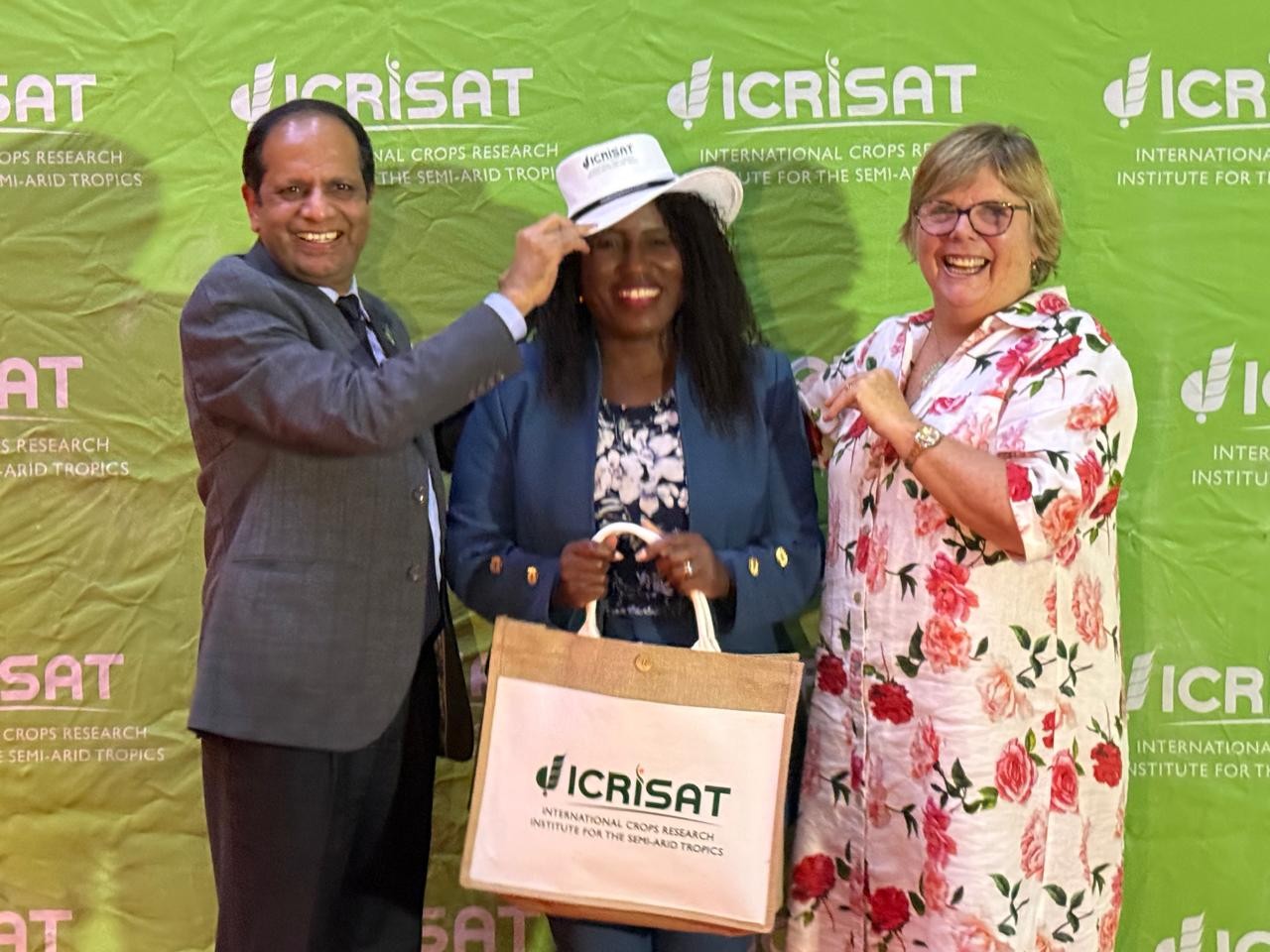
Speaking earlier on yesterday in Nairobi, ICRISAT Governing Board Chair Cathy Reade said sustained investment in science, research and partnerships would be critical as Africa confronts climate change, food insecurity and increasing pressure on natural resources.
Reade said research must increasingly move beyond laboratories and institutions to deliver practical solutions for communities living in the drylands.
“Our commitment is to ensure that research continues to translate into practical solutions for the communities that depend on the drylands,” she said, stressing the need for stronger collaboration between governments, universities, research institutions, the private sector and other partners.
ICRISAT’s mandate centres on improving dryland farming and agri-food systems while addressing hunger, malnutrition, poverty and environmental degradation across the drylands of Asia and Sub-Saharan Africa.
The engagement placed particular emphasis on the longstanding Kenya–India relationship and its potential to expand opportunities for Kenyan universities, students and researchers.
Reade said universities located in Kenya’s arid and semi-arid areas could play a much larger role in developing solutions for climate-resilient agriculture. Areas identified for collaboration include mechanisation, seed systems, water management, crop improvement and value addition.
Principal Secretary in Kenya’s State Department for Higher Education and Research, Dr Beatrice Muganda Inyangala, welcomed the initiative, describing higher education as central to developing the human capital required to transform agriculture in the country’s drylands.
“About 80 percent of Kenya is arid and semi-arid. For us, dryland agriculture is not agriculture at the margins; it is the agriculture of our future,” Dr Inyangala said.
She called for increased investment in universities, researchers and young people who can develop technologies and approaches suited to challenging dryland environments.
The PS also urged greater access for Kenyan students and researchers to training, fellowships, academic exchanges and collaborative research through the Kenya–India relationship and ICRISAT.
She said Kenya could benefit from India’s extensive agricultural experience while simultaneously contributing its own knowledge and innovations to the partnership.
Dr Inyangala singled out universities serving arid and semi-arid regions, including Garissa University and Tharaka University, as institutions that could become important centres of agricultural research and innovation.
She argued that such universities should not be viewed merely as institutions serving remote communities, but rather as potential centres of excellence capable of shaping the future of agriculture.
“These universities should not be seen simply as institutions serving remote communities. They can become centres of excellence for the agriculture of the future,” she said.
The government wants these institutions to establish stronger links with ICRISAT as well as universities and research organisations in India.
Dr Inyangala also pointed to ICRISAT’s longstanding collaboration with Egerton University as a foundation for expanding partnerships with more Kenyan universities.
The Kenyan Government is also seeking to expand its participation in the Maharishi initiative and ICRISAT’s Center of Excellence for South-South Cooperation in Agriculture, known as ISSCA.
ISSCA provides a platform for sharing and scaling agricultural innovations across the Global South, with areas of focus including crop improvement, agribusiness, digital agriculture, climate resilience and livestock production.
ICRISAT has already leveraged ISSCA and India’s Indian Technical and Economic Cooperation (ITEC) programme to facilitate international training in regenerative agriculture, digital agriculture, crop improvement and seed systems.
Dr Inyangala called for Kenya to secure greater opportunities under these initiatives, particularly for students, researchers and universities.
She said the ultimate goal should be to establish a stronger pipeline linking higher education, research, innovation, enterprise and farmers.
ICRISAT Director General Dr Himanshu Pathak said the institute would continue focusing on ensuring that scientific discoveries and innovations translate into solutions that farmers and communities can adopt at scale.
“No single institution can solve the food, climate and livelihood challenges facing the drylands,” Dr Pathak said, emphasising the importance of bringing together science, policy, education, industry and farmers.
He said ICRISAT’s strength lies not only in its scientific expertise but also in its ability to connect research and innovation with partners across countries and regions.
The institute’s objective, he added, is to move from knowledge to action, from research to innovation, from innovation to adoption and ultimately from adoption to measurable impact for farmers.
Dr Pathak brings more than three decades of experience in agricultural research, climate resilience and sustainable agricultural systems. He previously served as Secretary of India’s Department of Agricultural Research and Education and Director General of the Indian Council of Agricultural Research.
Dr Inyangala said Kenya should increasingly view its drylands not simply as areas facing agricultural constraints, but as investment opportunities with significant potential.
She identified drought-tolerant crops, improved seed systems, mechanisation, digital agriculture, water-efficient production, post-harvest management and value addition as areas requiring increased investment.
“When we invest in dryland agriculture, we are not investing in the margins of our economy. We are investing in its future,” she said.
The message comes at a time when climate variability, population growth, food insecurity and pressure on natural resources are increasing the urgency for agricultural systems capable of producing more with fewer resources.

