
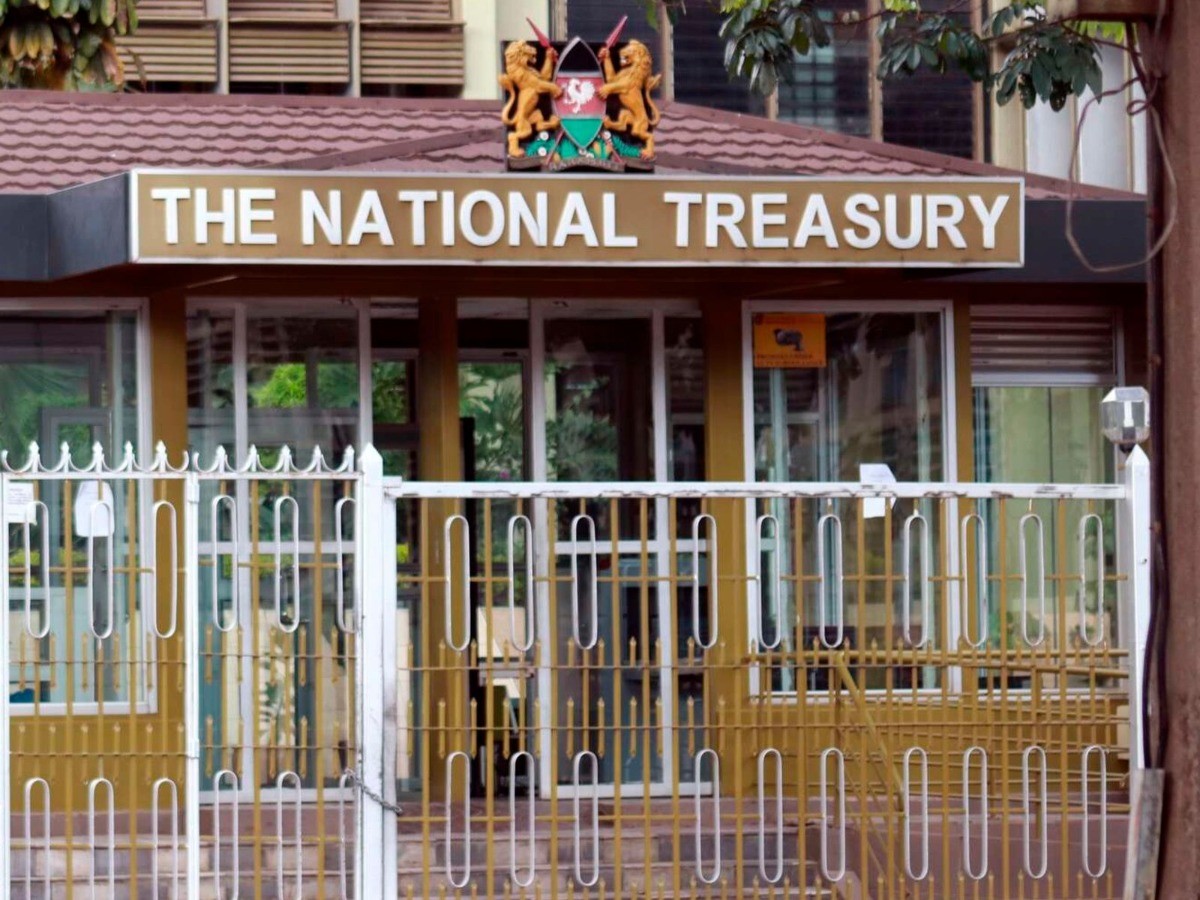
Kenya’s National Treasury Independence at Risk
Posted by EDITORIAL
Kenyas National Treasury at Risk over executive control threatening constitutional public-finance safeguards, while policy loopholes have enabled trillions in unapproved domestic borrowing.
In Summary
- Senator Okiya Omtatah warns that executive plans to shift the National Treasury from Chapter 12 (Public Finance) of the Constitution to Chapter 9 (Executive) would politicise control of public money, undermine constitutional checks and enable state capture.
- Major policy gaps have allowed more than KSh 4 trillion in domestic borrowing to bypass parliamentary approval, creating what Omtatah calls “audacious debts” that saddle Kenyans with obligations without proper oversight.
Also Read: Kenya's Debt Debate Shifts
Also Read: How Illicit Financial flows sits in Kenya’s Real Estate
Also Read: Nairobi Securities Exchange Breaks Ksh 3 Trillion ceiling
Kenya’s public finances sit at a critical crossroads. During yesterdays Kenya Editors Guild institutional dialogue held in partnership with the International Republican Institute, Busia Senator Okiya Omtatah delivered a stark warning: attempts to transfer the National Treasury from its constitutional home in Chapter 12 to the executive domain of Chapter 9 would invert the careful architecture designed to keep politicians at arm’s length from the nation’s money.
“The role of the National Treasury is clearly stated in Chapter 12 of the Constitution on the issue of public finance,” Omtatah stressed.
He told editors that plans by the executive to relocate those functions into Chapter 9 would place the Treasury under direct political control of the President and Cabinet Secretaries—contrary to the spirit and letter of the 2010 Constitution.
Chapter 12 establishes independent institutions, including the Commission on Revenue Allocation and the Controller of Budget, with the Treasury intended as a professional, non-partisan anchor. Omtatah argued that placing it under Chapter 9, which governs the executive, turns a neutral steward into a political instrument.
“When you mix executive power and money, you don’t get a servant. You get an emperor,” he said.
Politicians would then decide both the collection and the release of funds, eroding the separation that requires the civil service to implement budgets approved by Parliament.
The consequences, he warned, are already visible. Since the current administration took office, Parliament has approved only about one trillion shillings in new debt. Yet total borrowing has reached approximately 5.9 trillion shillings. The bulk of the difference, Omtatah charged, stems from domestic borrowing; bonds and related instruments—that has not received the parliamentary sanction the law requires. He described these as “audacious debts.” Under the Public Finance Management Act, only limited overdraft facilities are permitted without prior approval; longer-term domestic instruments demand legislative clearance. That clearance, he said, has largely been missing.
Omtatah linked the problem to a deeper design flaw. The Constitution envisages politicians proposing taxes and approving budgets, then handing implementation to professional public servants in an independent Treasury and Controller of Budget. Once the Treasury becomes an executive department headed by a Cabinet Secretary and Principal Secretary who serve at the President’s pleasure, that chain of accountability breaks. The result is a system in which access to resources depends on proximity to power rather than approved priorities—fueling the intense, existential contests for the presidency that characterise Kenyan politics.
The same logic, he argued, explains the persistence of pending bills. These are not public debt in the constitutional sense; public debt is a charge on the Consolidated Fund—but rather unpaid obligations arising when accounting officers commit funds they do not have or when released money is diverted.
“You don’t spend when you don’t have money. You don’t procure when you don’t have money,” Omtatah insisted.
Treating pending bills as first-charge items without rigorous verification, he added, opens the door to further abuse.
Kenya Editors Guild President Zubeidah Kananu framed the day’s discussion around the media’s duty to make these complex realities intelligible to ordinary citizens.
“Every time government borrows, every financing agreement it enters into and every expenditure commitment it makes eventually affects somebody,” she said.
“It affects the services people receive, the taxes they pay, the opportunities available to them and, ultimately, the obligations that our children and future generations will inherit.”
Kananu highlighted three practical priorities: clearer rules on confidentiality in bilateral and government-to-government deals; information presented in language citizens can actually use; and protection for journalists who report on sensitive debt and financing matters. She pointed to the ongoing public debate around the Dangote refinery agreement as a live illustration. Questions persist about the precise commitments Kenya has entered into, the fiscal risks involved, and the extent to which the terms should be disclosed. Where public resources and long-term obligations are at stake, she argued, legitimate commercial confidentiality must be balanced against the public’s right to know what is being done in its name.
Other speakers reinforced the call for stronger follow-through. Deputy Auditor General FCPA Edwin Kamar urged greater media attention to performance audits that examine whether public resources deliver intended results. Alexander Riithi of The Institute for Social Accountability stressed that public participation must be consequential across both the main budget and supplementary estimates, and that findings by the Auditor-General, Controller of Budget and Parliament too often go unheeded. Senior Legal Counsel Lynn Odhiambo of the Commission on Administrative Justice reminded participants that where public funds are involved there is a clear basis for seeking information, even while recognising limited exceptions for protected data.
READ BUSINESS AND INVESTMENTS NEWS HERE
Omtatah closed by appealing to the media’s unique capacity to educate. He recalled writing about public debt as early as 2008 and urged journalists to examine the monthly Statement of Actual Revenue and Net Exchequer Issues alongside the approved budget. Doing so, he said, would reveal the scale of domestic borrowing that has escaped parliamentary scrutiny. He also called for structured technical briefings so that reporters can master the intricacies of Chapter 12 and report them accurately.
The dialogue produced a 24-item issues and follow-up matrix. Success, Kananu emphasised, will not be measured by the quality of conversation in the room but by whether information becomes easier to access, institutions respond to questions raised, and ordinary Kenyans gain a clearer understanding of how their money is borrowed and spent. For a country whose Constitution deliberately placed public finance under independent safeguards, the stakes could scarcely be higher.

