
IGAD Ministers Back Digital Visa and Stronger Labour Migration Framework to Boost Regional Integration
Posted by JIM MWANDA
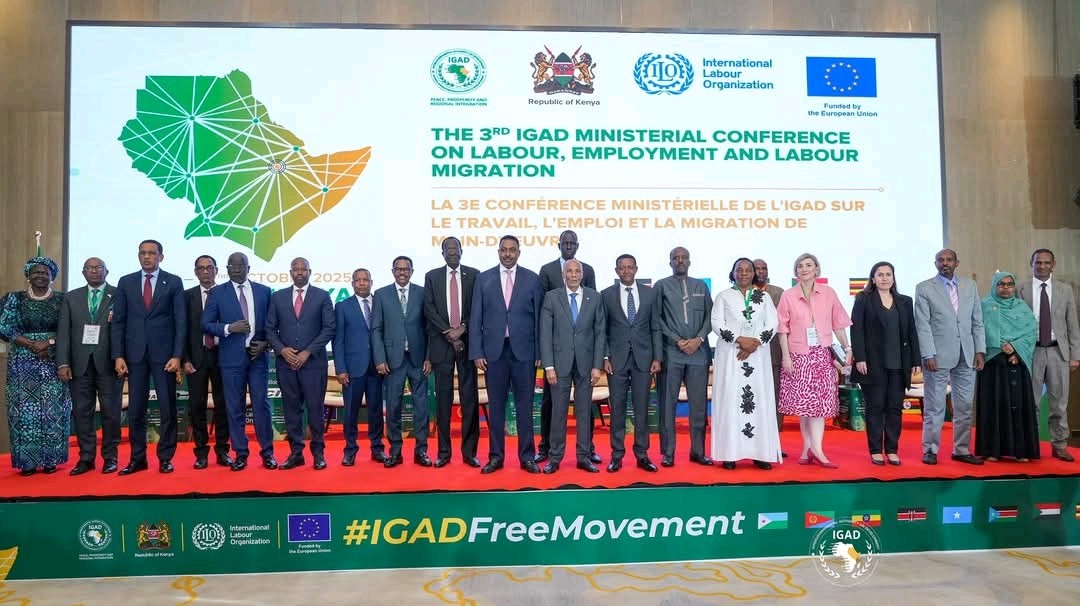
IGAD’s 3rd Ministerial Conference on Labour, Employment, and Labour Migration concludes in Nairobi with calls for stronger regional action on safe migration, youth employment, and the new IGAD Single Digital Visa to boost integration.
Nairobi Kenya
In Summary
- The 3rd IGAD Ministerial Conference in Nairobi focused on strengthening labour migration governance, youth employment, and regional mobility across the Horn of Africa.
- Delegates reviewed progress on the Djibouti Declaration and discussed key priorities, including safe migration, the Red Sea Route crisis, and the proposed IGAD Single Digital Visa system.
- Ministers are set to adopt a communiqué outlining concrete commitments and launch the EU-funded Free Movement and Transhumance Project (FMPT II) to advance regional integration.
Co-hosted by the Government of Kenya in collaboration with the International Labour Organization (ILO) and with financial backing from the European Union (EU), the high-level meeting brought together ministers, senior government officials, employer federations, trade unions, and international partners from IGAD Member States. The two-day experts’ session preceding the ministerial segment laid the groundwork for concrete policy recommendations aimed at advancing fair, safe, and productive labour migration within and beyond the region.
Held under the theme “Improving Labour Migration and Mobility Governance for Prosperity,” the conference’s central objective has been to accelerate the implementation of the Djibouti Declaration on Labour, Employment, and Labour Migration, adopted four years ago. This declaration serves as the region’s main policy framework for coordinating migration and employment governance across seven pillars; ranging from protection of migrant workers’ rights to promoting decent work, social protection, and fair recruitment.
READ: Media Empowered to Champion Safe and Fair Labour Migration in Kenya
READ: Israel–Hamas truce: Donald Trump says “the war is over” as first hostages return to Israel
READ: Paris Louvre Heist: Daring Four-Minute Raid Steals Priceless Napoleonic Jewels
The Nairobi meeting provided a platform for delegates to review progress under these pillars and identify bottlenecks that continue to hinder full implementation. The discussions were anchored on three key regional priorities:
- Labour, Employment, and Labour Migration:Tracking progress made since the Djibouti Declaration and strengthening institutions that support job creation and protection for migrant workers.
- The Red Sea Route Migration Crisis: Addressing humanitarian, labour, and security challenges linked to irregular migration through coordinated cross-border responses and partnerships with destination countries.
- The IGAD Single Visa Initiative: Advancing the proposal for a unified digital visa system to enhance mobility, trade, and investment while reducing barriers for travellers and promoting regional integration.
During the opening, Dr. Workneh Gebeyehu, IGAD Executive Secretary, underscored that the region faces an urgent need to translate policy commitments into tangible action. Citing the alarming rise in irregular migration through the Red Sea route; where over 60,000 migrants were recorded arriving in Yemen in 2024: he urged member states to adopt a “whole-of-route” approach that tackles root causes of migration, enhances protection mechanisms, and dismantles human trafficking networks.
“Across our region, 62 million people face food insecurity while 25 million have been displaced. Behind these numbers are young people seeking dignity through work and opportunity,” Dr. Gebeyehu stated. “This conference must move us from statements to systems, from aspiration to action.”
Kenya’s Commissioner of Labour, Hellen Apiyo, emphasized the importance of regional solidarity in safeguarding the rights of migrant workers and creating employment opportunities for youth.
“As a region, we must develop solutions that protect workers and expand decent work opportunities—especially for the millions of young people entering the labour market,” she said.
Other dignitaries, including Souleimon Meimin Robleh of Djibouti, Mangar Buong Acok of South Sudan, and Amb. Moussa Ali Meigague of IGAD, echoed the need for enhanced cooperation, improved labour standards, and stronger bilateral labour agreements with destination countries. They stressed that safe and legal migration pathways are critical not only for economic growth but also for peace and stability across the IGAD region.
The conference also saw renewed focus on the IGAD Single Visa Initiative, an EU-supported proposal designed to facilitate free movement within the region. The digital visa system, once operational, is expected to harmonize travel regulations, reduce bureaucratic barriers, and stimulate trade and tourism—aligning with the broader African Continental Free Trade Area (AfCFTA) goals.

H.E Dr. Workneh Gebeyehu giving Remarks
In his remarks, Dr. Gebeyehu highlighted that the IGAD 2026–2030 Strategic Plan will place labour and livelihoods at the heart of regional integration, recognizing that peace and climate resilience are inseparable from economic opportunity. The plan also integrates lessons from the Doha Dialogue launched in 2024, emphasizing the need for binding commitments, monitoring mechanisms, and accountability to ensure that policy promises translate into real impact.
As the conference concludes, ministers are expected to adopt a Ministerial Communiqué outlining actionable commitments to strengthen labour migration governance, implement fair recruitment practices, and operationalize social protection portability across borders. The event will also officially launch the second phase of the EU-funded Support to Free Movement of Persons and Transhumance Project (FMPT II), aimed at deepening regional integration and supporting cross-border livelihoods.
The Nairobi conference reaffirms IGAD’s commitment to transforming migration from a source of vulnerability into a driver of prosperity. The message from delegates has been clear: the future of the region depends on turning the migration challenge into a shared opportunity—one built on dignity, equity, and cooperation.

